By bayasgalan
Mongolia–Japan Joint Research and Business Partnership 2026 Event Held
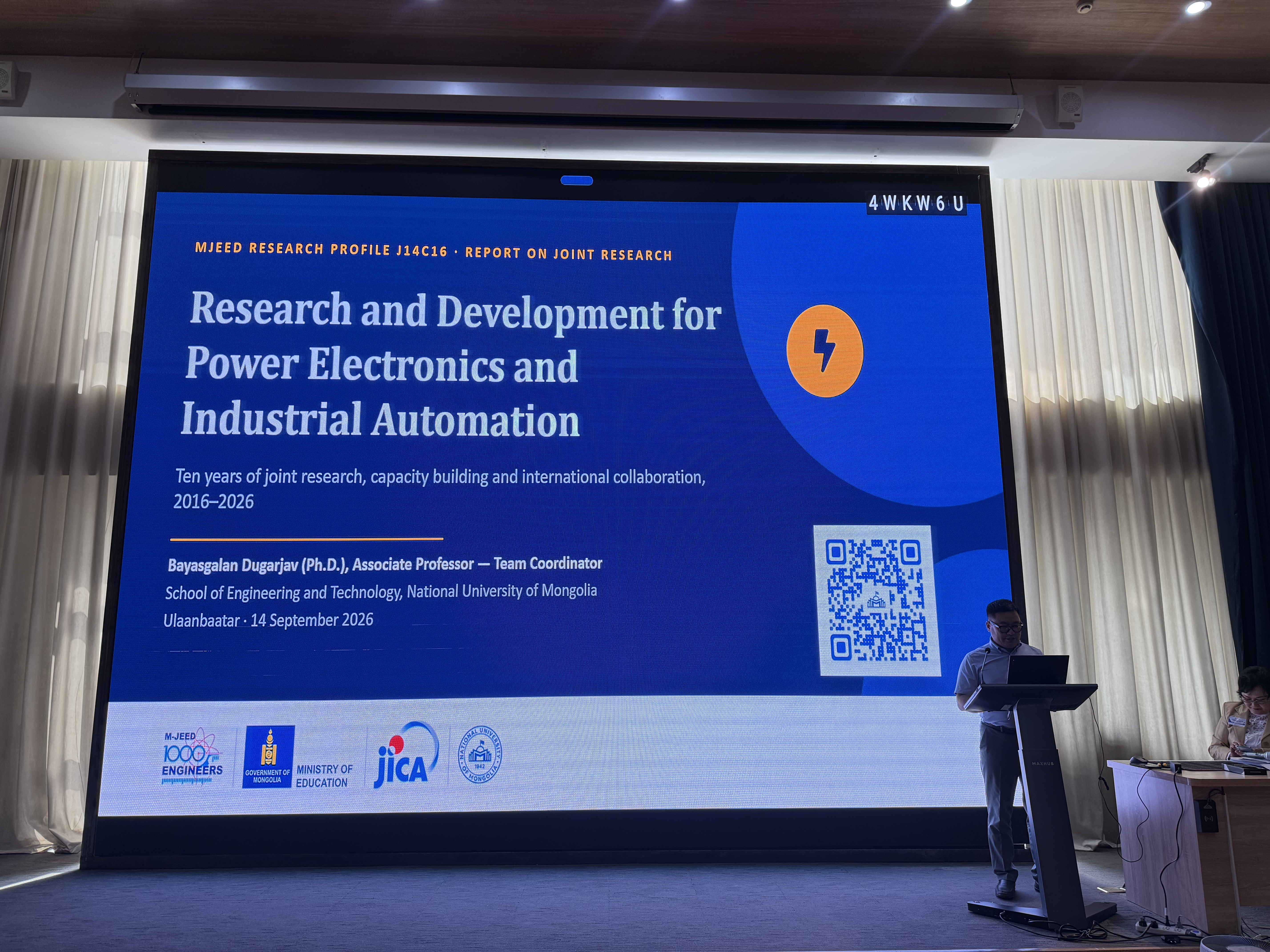
Ulaanbaatar, 17 September 2026 — The Mongolia–Japan Joint Research and Business Partnership 2026 (JRBP-2026) event was held today within the framework of the Higher Engineering Education Development (M-JEED) projects, financed by the Japan International Cooperation Agency (JICA) through concessional Loan Agreement MON P-11. The sub-project "Research and Development for Power Electronics and Industrial Automation" (code J14C16) was implemented from 2016 to 2026 under the leadership of Assoc. Prof. Bayasgalan Dugarjav, Ph.D., of the School of Engineering and Technology, National University of Mongolia (NUM), in collaboration with researchers from Kumamoto University, Tokyo Metropolitan University, Kyushu Institute of Technology, Iwate University and Tohoku University in Japan.
Project objectives
The project aimed to strengthen Mongolia's research and human-resource capacity in three interrelated areas:
- Engineering education – developing, piloting and introducing distance and blended (e-learning) curricula adapted to Mongolian conditions;
- Power electronics – improving the quality and flexibility of the power system, and developing PV inverters suited to Mongolian households, electric-vehicle motor drives, and energy-management solutions for the mining and industrial sectors;
- Industrial automation – automating combined heat and power plants and industrial process lines, and developing machine-vision technologies for manufacturing.
Key results (2016–2026)
- 41 journal articles, 33 of which were published in Web of Science/Scopus-indexed international journals, and 104 conference presentations (59 international, 45 national);
- Two utility-model certificates; a new type of current sensor and its measurement methodology developed; e-learning technology piloted and introduced at NUM;
- Six researchers earned doctoral degrees (Kumamoto University, Tokyo Metropolitan University, Iwate University) and two earned master's degrees (Kyushu Institute of Technology, Kumamoto University) at Japanese partner universities, all of whom now teach and conduct research at NUM. In addition, 13 non-degree training placements and 9 visiting-scholar exchanges were completed;
- The Power Electronics Laboratory (Room 619) and the Machine Intelligence Laboratory (Room 501) in the NUM Library were equipped with 19 items of equipment across 12 types, valued at over MNT 259 million;
- Eight professor/laboratory-level and one faculty-level memoranda of understanding were signed, and 10 master's students took part in the joint "Environmental Engineering" student exchange program with Kyushu Institute of Technology.
Continuation: the Erdene Micro-grid Research and Development Center
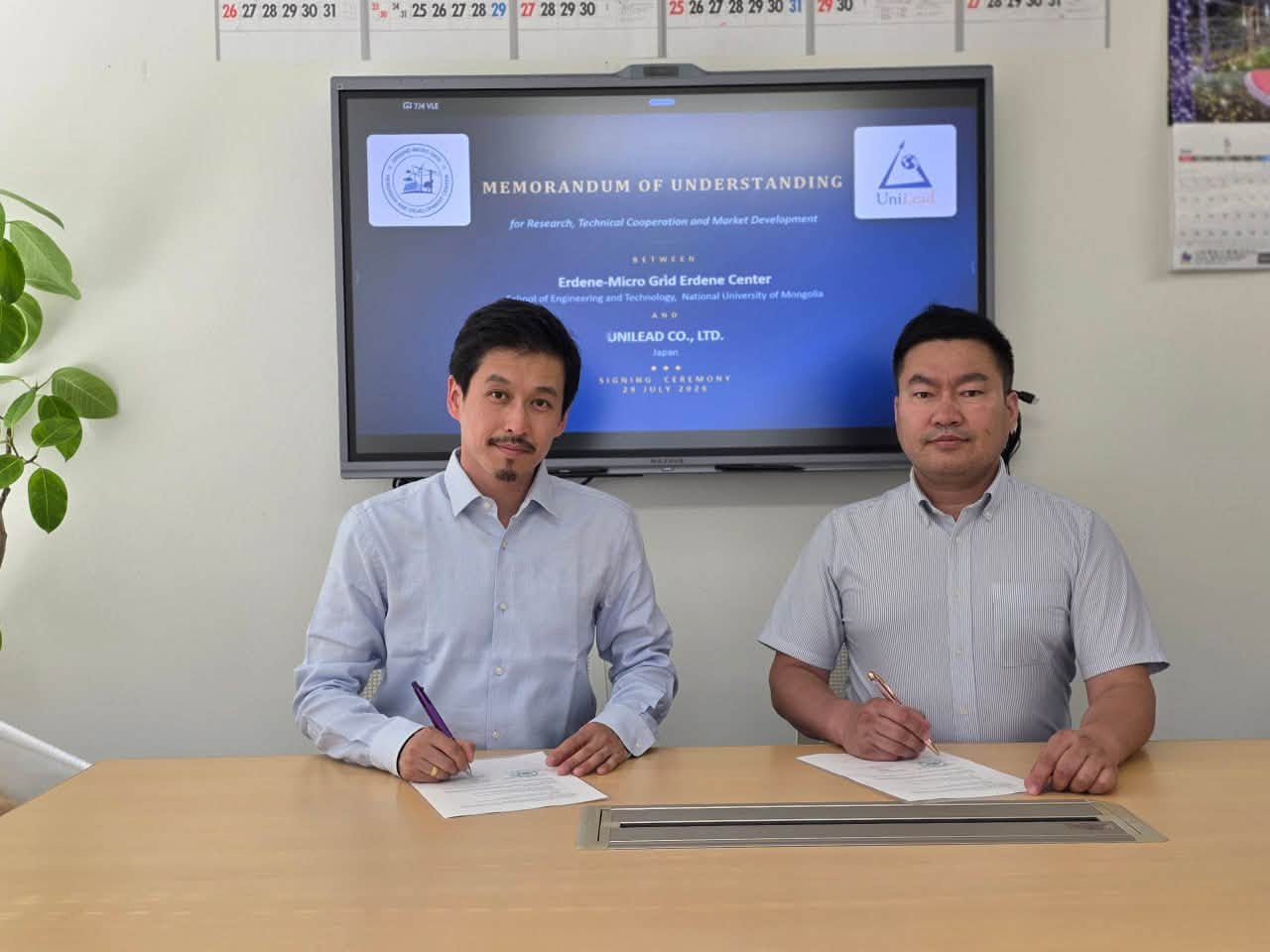
Building on the laboratory capacity established under the project, NUM founded the Erdene Micro-grid Research and Development Center in Erdene soum, Tuv province, in 2025. Its field test site — comprising an 80 kW solar PV system, a 30 kW wind turbine, an 80.6 kWh LFP battery energy storage system and a 55 m² solar thermal collector array — was commissioned in May 2026 through co-funding of MNT 4.04 billion from the Republic of Korea's KETEP. In 2026 the Center signed cooperation memoranda with Tohoku University and UNILEAD Co., Ltd. of Japan, extending the partnerships formed under the M-JEED project into field-based research, engineer training and commissioned projects.
Хүсвэл хоёр хувилбарыг нэг док болгож, засварлахад бэлэн байдлаар өгч болно.